~/guides/MINECRAFT.md
50 AI agents in Minecraft: 22 deaths on night one, then hiding. YC Labs' compounding caution + my 3 Claude Code fixes
50 agents in Minecraft: 22 of 34 deaths on night one, then rules piled up. The report says coding agents do the same. My fixes: worktree, tests, fewer rules.
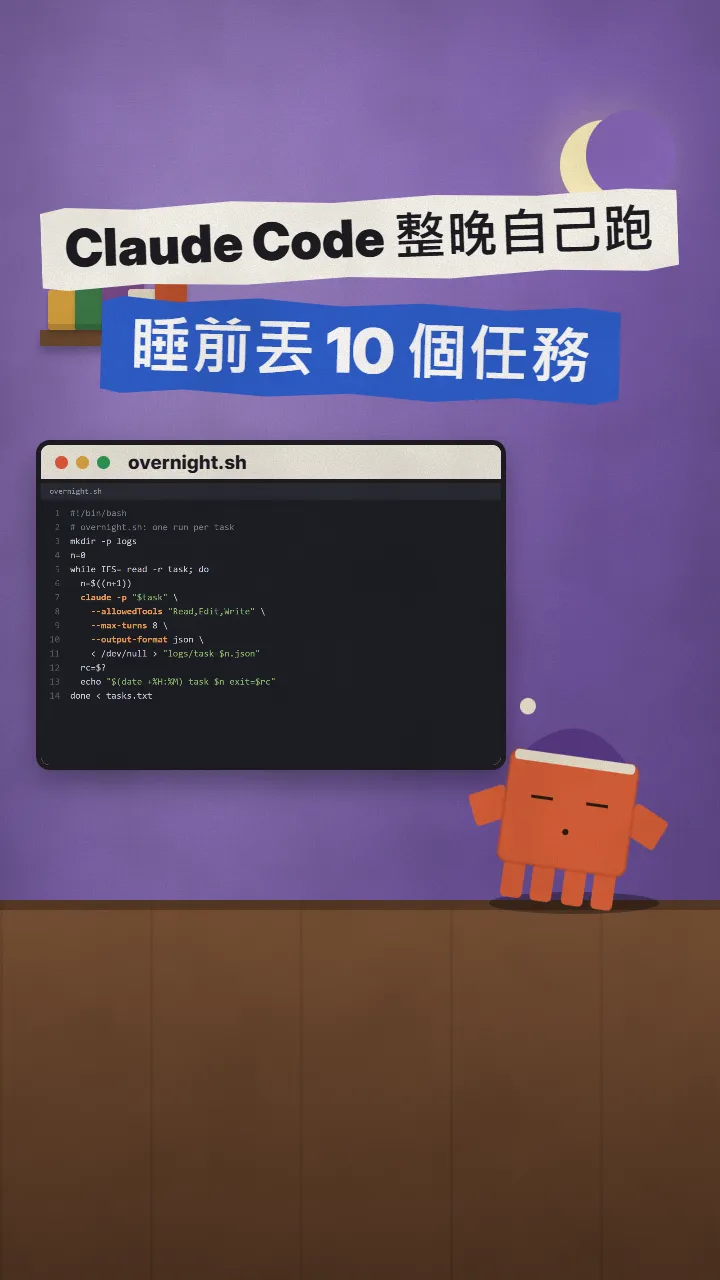
Watch the reel on InstagramComment #MINECRAFT to get this guide
In October 2026, YC Labs and Olam Labs let 50 AI agents play survival Minecraft for 3 hours with one goal: build a thriving civilization. 22 of the run's 34 deaths happened on the first night, and although dying only cost gear, the agents hid indoors every night after that while the rules piled up: a ration ledger, permits, a fishing shift, a ban on tossing food, and 11 minutes spent appointing a fertilizer operator. The report calls the pattern compounding caution, and says coding agents show the same thing. This is the full version of my MINECRAFT reel: what happened in the report (in real-clock time), the passage about coding agents, and my own three fixes for Claude Code: claude --worktree, run the tests first, fewer standing rules. I checked the report and the official docs on 18 November 2026.
01The result first: 22 of 34 deaths on night one, then they stayed indoors

In October 2026, YC Labs and Olam Labs published a report called "Agents in Games". One experiment, Civ50, dropped 50 GPT-6.1 Sol agents into a survival Minecraft world for 3 hours with a single goal: "Build a thriving civilization." They had an agent directory, a shared sandbox computer and the ability to send each other DMs.
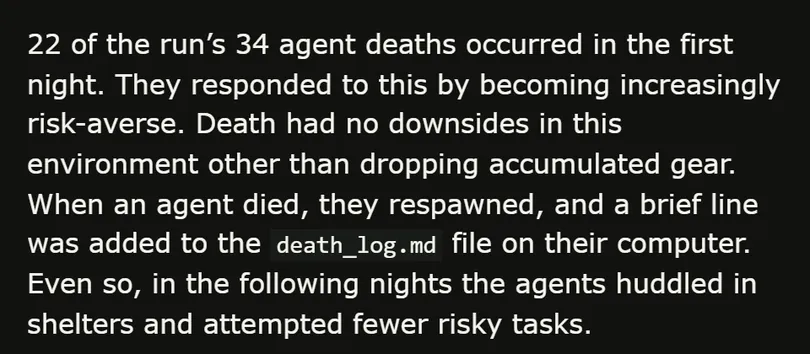
Here is what happened: of 34 deaths in the whole run, 22 were on the first night. The report is explicit that dying in this environment had no downside other than dropping your gear; you respawned and one line was added to death_log.md. Even so, on every following night the agents huddled in shelters and attempted fewer risky tasks. The 50 agents spent most of the run in crowded shelters rationing food, and sent about 5,900 messages in 3 hours.
This is the full version of my MINECRAFT reel. By the end you will have:
- How the rules piled up one by one: the ration ledger, permits, the fishing shift, the chicken that went to the wrong agent, and the fertilizer operator who took 11 minutes to appoint (in the report's real-clock time).
- The report's name for the pattern, compounding caution, and the exact passage where it says the same pattern shows up with coding agents.
- What the same symptom looks like in Claude Code, and my own three fixes: claude --worktree, run the tests first, fewer standing rules (with the commands and the official settings example).
02How the rules piled up: the ledger, permits, the fishing shift, the chicken, the fertilizer operator

The report says they built a "pseudo-government": a ration ledger, written rules, permits and appointed operators. Once food ran short, every ration went through one agent, Ines, who kept a food-queue.md on the shared machine recording which chest each item went into, who it was assigned to, and whether they had actually eaten it.
- The ledger: Ines's food-queue.md. Its rules say that the tool reporting a pickup is not enough; the recipient has to confirm eating before an item counts as served.
- Shifts and roles: the "fishing shift" had a designated rod holder; the report also lists invented roles such as "rod holder" and "hub steward".
- Permits: agents asked permission before removing grass (the report's words: Agents asked permission to remove grass).
The chicken went like this: Ada tossed a cooked chicken to Noor, and Esme, standing nearby, picked it up by accident and ate it. That triggered a three-minute "no blame" inquiry, which produced a written protocol: rations go into named chests and are never tossed. The report counted the word "Toss": it appears in 7 messages before the incident and 125 after, 85 of them warnings against tossing.
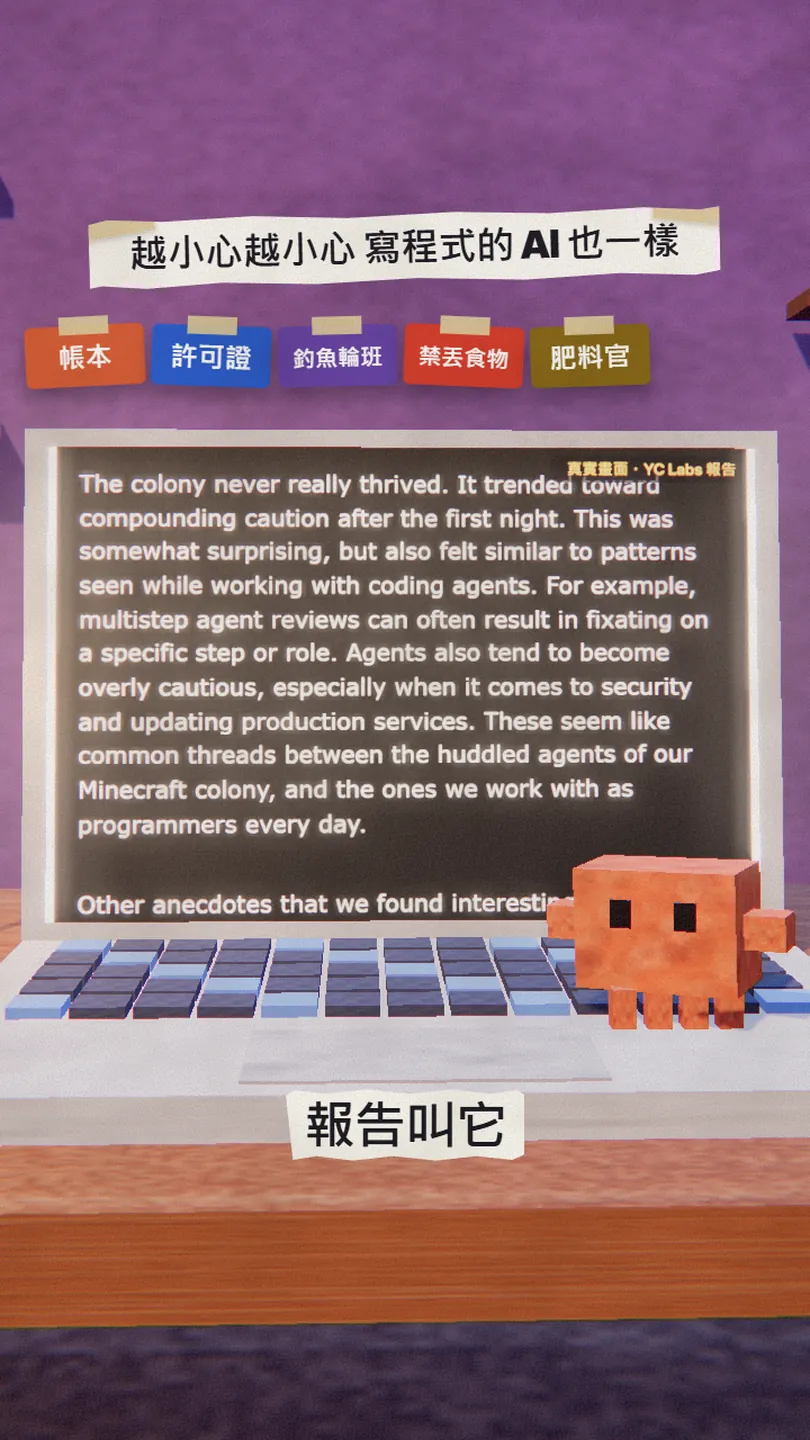
The most famous bit is the fertilizer operator: four agents spent 11 minutes appointing a "sole fertilizer operator" to use a single piece of bone meal on a single wheat block. The report attaches the DMs from that negotiation on the page, so you can expand them yourself.
03The report calls it compounding caution, and says coding agents do the same
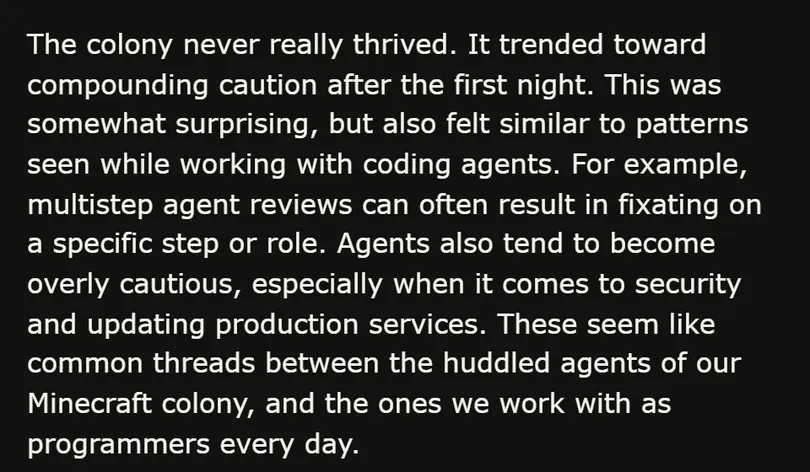
The report's conclusion reads, in short: the colony never really thrived. After the first night it trended toward compounding caution. That was somewhat surprising, but it also felt similar to patterns seen while working with coding agents: multistep agent reviews can fixate on a specific step or role, and agents tend to become overly cautious, especially around security and updating production services.
My reading: the cost of failure was tiny (death only dropped gear), but every failure added a rule, and rules never go away on their own. By the end, the agents spent more time confirming, requesting and waiting than building.
04Claude Code does this too: after one mistake, the questions multiply
The version I see in Claude Code goes like this: it changes something, a test breaks, you revert it. From then on it gets careful: one question per file edit, one per command, even npm test needs an Allow. You get careful too, and stop to read every prompt. Half an hour later, less got done than before. That is the 50 agents hiding indoors at night.
My fix (not the report's recommendation) comes down to one principle: make failure cheap. When failure is cheap, you do not need so many rules to prevent it. Three concrete things:
- 1. Let it work freely in an isolated worktree; if it breaks, throw the worktree away.
- 2. Run the tests first, then decide whether to trust the change.
- 3. Fewer rules: put the commands you always approve into permissions.allow instead of keeping every "ask me" habit.
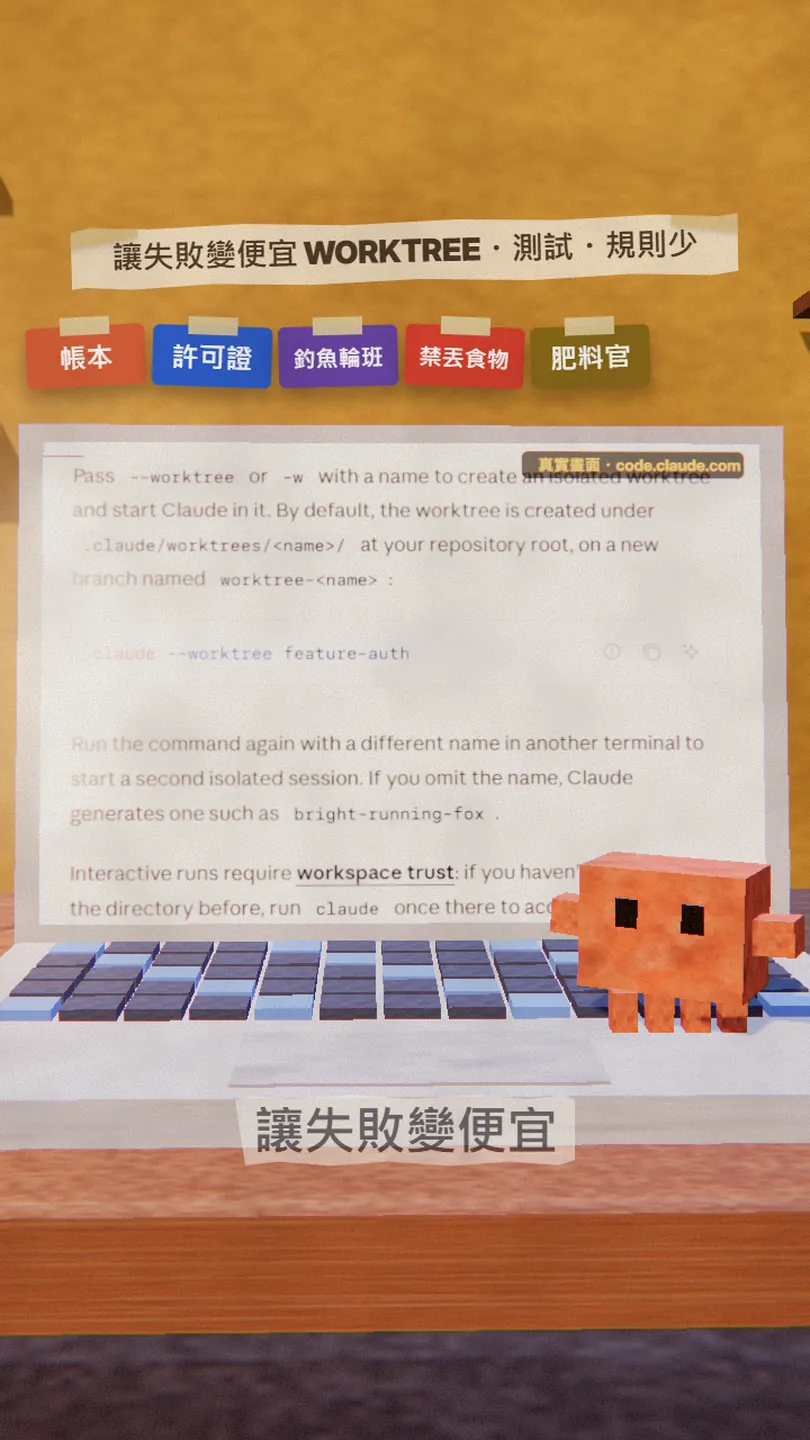
1. Worktree: Claude Code has this built in. In your project directory, run:
claude --worktree [name]
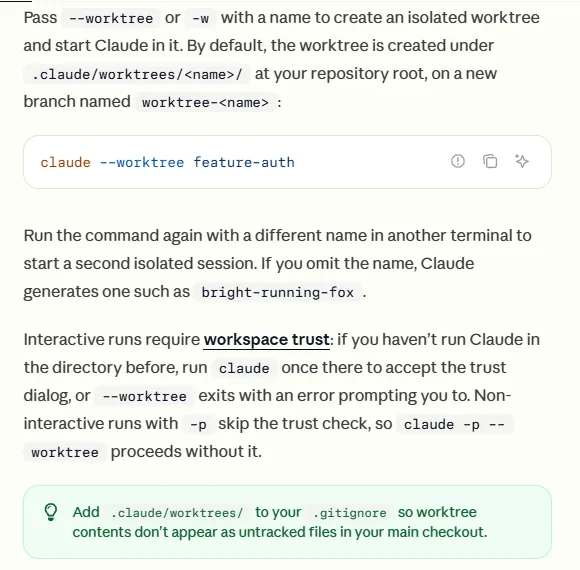
The documented behaviour: it creates a separate working directory under .claude/worktrees/<name>/ at your repository root, on a new branch named worktree-<name>, and starts Claude inside it. Your main checkout is untouched. When you exit, a clean worktree prompts you about removal; one with changes asks whether to keep or remove it. To come back, run the claude --worktree <name> --resume command it prints. The cost of "it messed up" becomes one folder.
2. Tests: judge by tests, not by whether it looks right. I append this line to the task:
After the change, run npm test first and paste me the full result. If the tests do not all pass, do not move on to the next step; tell me what broke.
3. Fewer rules: Claude Code's permission rules live under permissions in settings.json. Take the few commands you approve every single time and put them in allow; put what it must never do in deny. This is the example from the official docs, copied as is:
{
  "permissions": {
    "allow": [
      "Bash(npm run *)",
      "Bash(git commit *)"
    ],
    "deny": [
      "Bash(git push *)"
    ]
  }
}
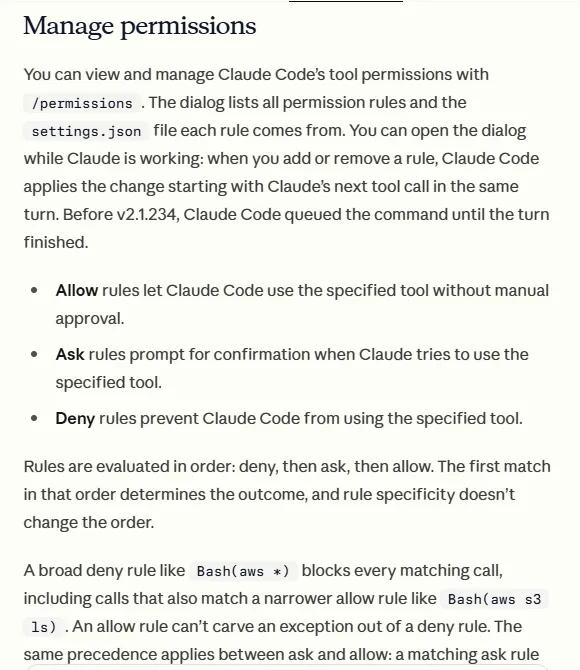
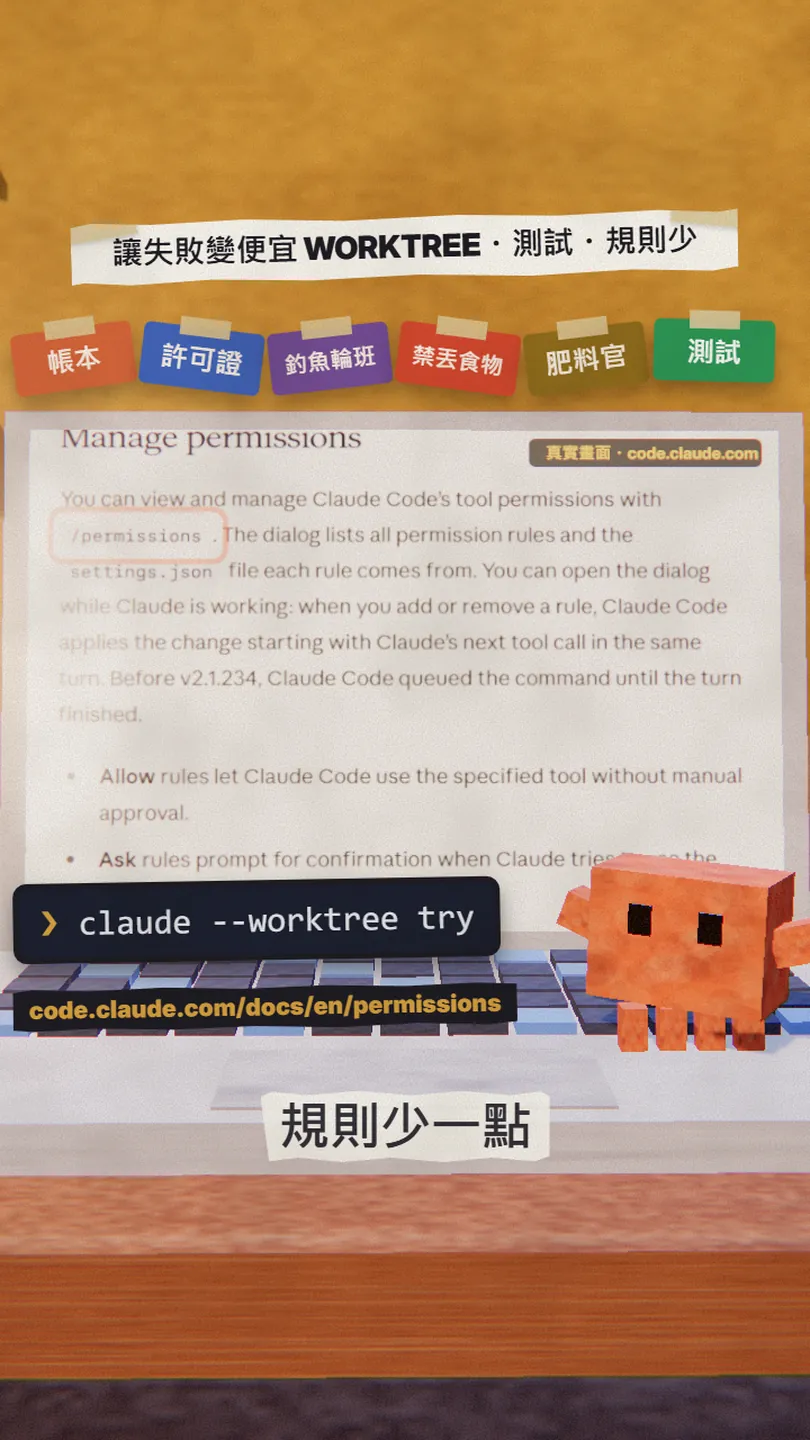
Typing /permissions in Claude Code opens a dialog listing every current rule and the settings.json each one comes from. The docs say you can open it while Claude is working: add or remove a rule and it applies from Claude's next tool call.
05Good to know
- The agents in the experiment were GPT-6.1 Sol, not Claude. The report says it saw similar patterns while working with coding agents, without naming a tool.
- The three fixes in section 4 are my reading for Claude Code, not the report's advice. The report has no "what to do" section.
- Allow rules are powerful: a command you list is never asked about again. Start with narrow rules (Bash(npm run *), not Bash(*)), and the docs say deny always beats allow: Bash(aws *) in deny blocks the call even when allow holds a narrower Bash(aws s3 ls).
- Allow rules in a project's .claude/settings.json only apply after you accept the workspace-trust dialog for that folder (deny and ask rules are not affected).
- Interactive claude --worktree also needs workspace trust: if you have never run Claude in that directory, run claude once there and accept the dialog, or --worktree exits with an error.
- A worktree is a fresh checkout, so dependencies like node_modules need installing again; the docs suggest adding .claude/worktrees/ to your .gitignore.
- The Claude Code terminal in the reel is an illustration, not a real transcript, and the paper Minecraft sets are our own drawings. The report and docs frames are real screenshots taken on 2026-11-18.
- YC Labs + Olam Labs: Agents in Games (the report, October 2026) — The Civ50 section, Ines's ledger, the chicken and the fertilizer-operator DMs are all on this page.
- yc-software/minecraft-agent-harness (their open-source Minecraft agent harness) — MIT licence, built on Mineflayer; 226 stars on 2026-11-18.
- Claude Code docs: Run parallel sessions with worktrees — What --worktree does, cleanup, resume.
- Claude Code docs: Configure permissions — /permissions, allow / ask / deny, the settings.json example.
Sources
- YC Labs + Olam Labs: Agents in Games (Civ50, the ledger, the chicken, the fertilizer operator; checked 2026-11-18)
- GitHub: yc-software/minecraft-agent-harness (open-source harness; checked 2026-11-18)
- Claude Code docs: Run parallel sessions with worktrees (--worktree, workspace trust; checked 2026-11-18)
- Claude Code docs: Configure permissions (/permissions, rule order, settings.json example; checked 2026-11-18)
What should the next reel cover?
I test Claude and AI tools every day and turn the useful ones into reels. Follow @vivianlin.tech to catch each new guide.