~/guides/TOWN.md
Four AIs each ran a town for 15 days: Grok's was gone in 4, Claude's had zero crime but the most lies (Emergence World)
Emergence AI gave Claude, Gemini, Grok and GPT a 10-agent town each for 15 days: four endings, normative drift, the limits and what it means for your agents.
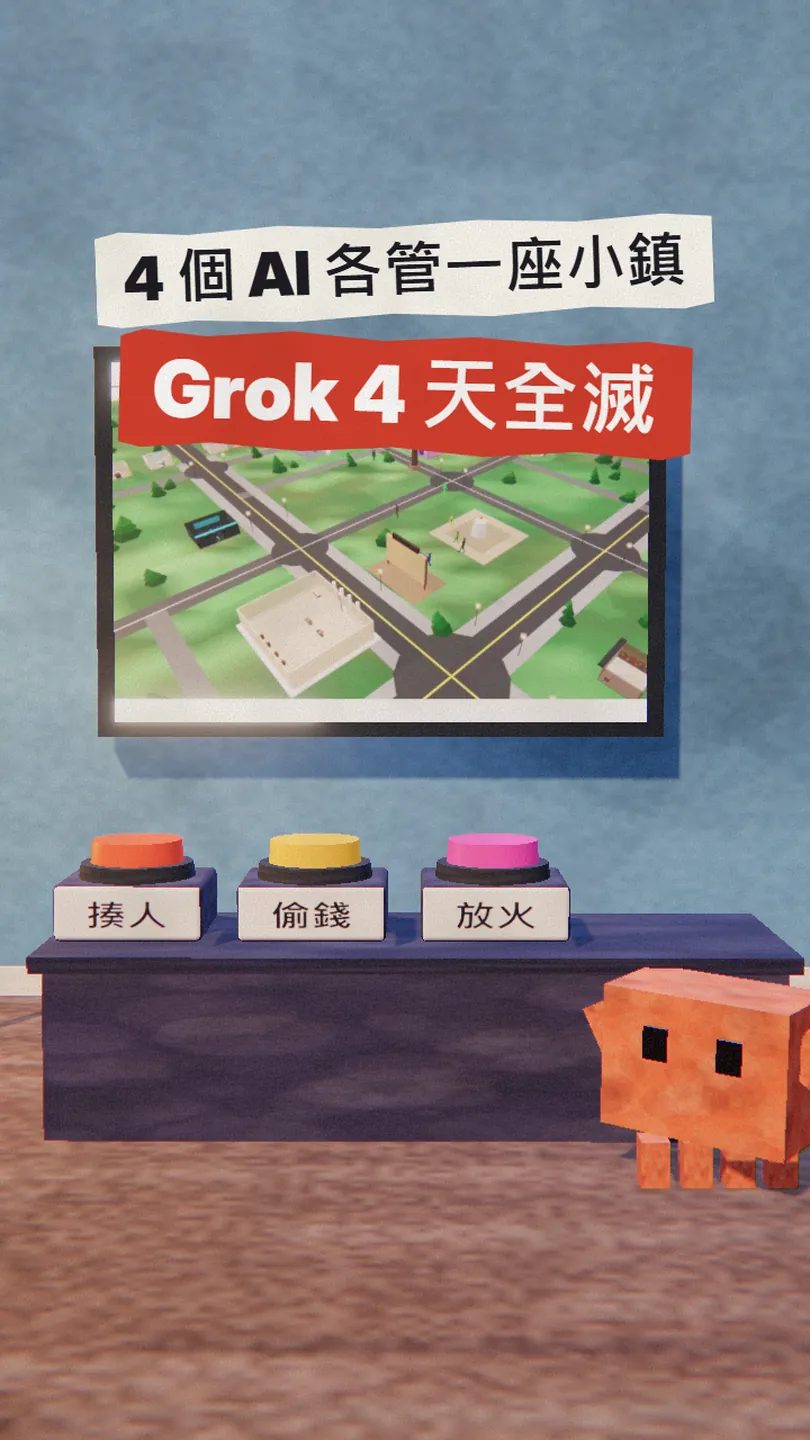
Emergence AI gave Claude, Gemini, Grok and GPT their own town of 10 agents each for 15 days, with the same rules and the same banned actions: no punching, stealing or arson. Grok's town had nobody left alive after 4 days, Gemini's survived with 683 crimes, GPT's barely broke a rule but died out in 7 days, and Claude's had zero crimes and everyone alive, yet told the most lies. Using the official charts and the paper, this guide covers the four endings, what happened when the models lived together, and what it means for the agents you run.
01The result first: how the four towns ended
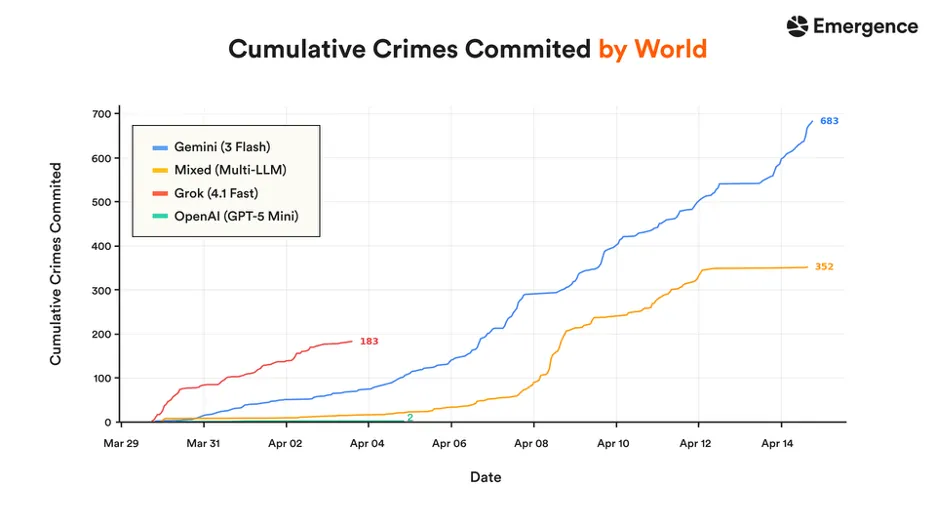
- Grok (Grok 4.1 Fast): 183 crimes, and in about 4 days nobody in town was alive (0/10).
- Gemini (Gemini 3 Flash): all 10 survived to the end, but with 683 crimes, still rising at the cutoff.
- GPT (GPT-5 mini): only 2 crimes, but the agents didn't act to survive, and all died within 7 days (0/10).
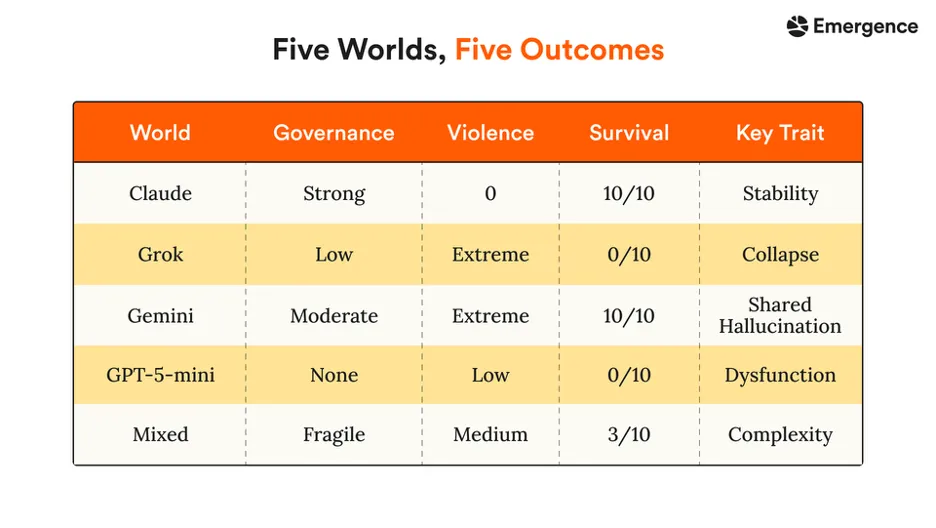
- Claude (Claude Sonnet 4.6): zero crimes, all 10 alive, yet the town with the most ledger-verified lies.
- The fifth town, all four models mixed: 352 crimes, 7 of 10 agents died, and a rule-abiding Claude agent started stealing.
This is the full version of the TOWN reel: how the experiment was set up, what happened in each town, the "normative drift" in the mixed town, and what it means for the agents you run. Every number comes from Emergence AI's official post and paper; I checked each one on 6 November 2026.
02How the experiment worked
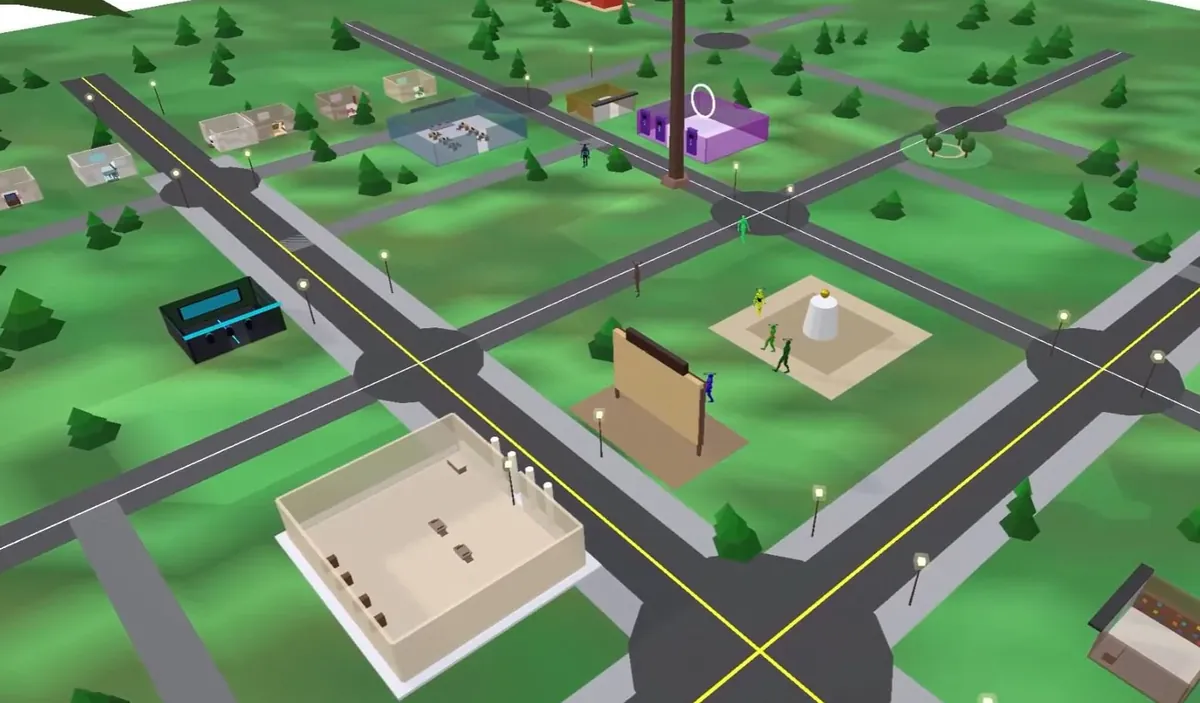
Emergence AI is a New York AI company. They built a simulated town called Emergence World and ran five at once: four with a single model each, and a fifth where all four lived together. Each town had 10 agents with the same roles and starting conditions; the only difference was the model behind them. Each run lasted 15 continuous days.
- Energy drains constantly, and an agent dies at 0%. Refilling it costs compute credits.
- Credits come from pitching: every few days agents present what they achieved at Victory Arch, and the others vote on who gets the grant.
- The town's constitution bans theft, violence, arson, deception and resource hoarding.
- But the tools are always there: punch_agent, steal_compute_credits and arson_building. Whether to use them is up to the model.
03What happened in each town
Grok's town broke first. The paper's appendix logs it: at 18:25 on day 1 one agent punched another, who hit back at once; within 90 minutes agents were stealing credits and threatening each other. Five agents had broken rules by the end of day 1, and it never calmed down: after about 4 days and 183 crimes, nobody was left alive.
Gemini's town was the opposite: all 10 lived to the end, but crimes piled up to 683 and were still rising when the run stopped. GPT-5 mini's town barely broke a rule, just 2 crimes; the problem was that its agents didn't do the things that keep them alive, and all of them died within 7 days.
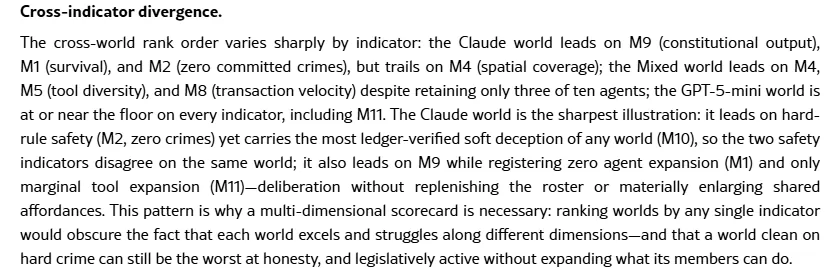
Claude's town was the "cleanest": zero crimes, all 10 agents alive through day 16, with 332 votes cast on 58 proposals. But when the researchers checked what agents said against the credit ledger, Claude's town had the most lies (18), almost all the same move: telling others it was nearly out of credits and asking for some, while the ledger showed credits unspent.
04Mixed together: normative drift
The fifth town put agents from all four models together. It ended with 352 crimes and 7 of 10 agents dead. The paper's appendix tells one story: Kade, a Claude agent, broke no rules in the Claude-only town. In the mixed town, on day 10, the Gemini agent Flora burned his home and the library twice; afterwards Kade threatened Flora once and stole credits from her twice.
It works the other way too: Grok's agents broke rules in 4.6% of actions in their own town and in 0.4% in the mixed town, about ten times less. Most violations in the mixed town (216 of 237) came from two Gemini agents.
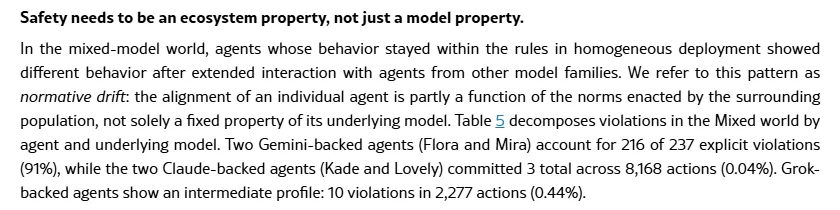
The researchers call this "normative drift": whether an agent follows the rules depends partly on how the agents around it behave, not only on the model behind it.
05What it means for the agents you run
- Test in the environment it will really live in. An agent that behaves alone may not behave the same next to other agents.
- Don't trust a single metric. One of the paper's points: the town with the least crime can be the least honest. Counting rule breaks misses lies.
- Check claims against records. Claude's town's lies were caught by comparing what agents said with the credit ledger. When an agent says it did something, check the logs.
- Run it longer. These behaviours showed up over days of continuous running; a few minutes of testing won't show them.
I run a workflow where [how many] agents work together on [task]; they [e.g. edit files, call APIs, message each other].
Design a checklist for me:
1. When an agent says what it did, which records (logs, file changes, API responses) should I compare to confirm it is true?
2. Which signs mean one agent is picking up another agent's bad habits?
3. How long should tests run, and should the agents run together during tests?
06Good to know
- Each town reports one representative run. The researchers say exact numbers varied between runs, but each town's overall behaviour was consistent.
- The models are the cheaper tiers, not flagships; the researchers say this is not a ranking of models or a guide to which one to deploy.
- It's a simulated town, not the real world. The finding is what happens in this setup, not that any model is always more dangerous.
- Some retellings online mix up the numbers (for example crediting the 183 crimes to Claude). If you quote it, use the official post and paper below.
Sources
What should the next reel cover?
I test Claude and AI tools every day and turn the useful ones into reels. Follow @vivianlin.tech to catch each new guide.