~/guides/LEARN.md
Learn a new framework with Claude: 4 codes in order (/80-20, /ELI5, /socratic, /quizme) for a one-page plan and a quiz
The 4 codes aren't built in; they're a prompt you paste into a Project. Full setup, each code, and the real plan + quiz we got for React Server Components.
Watch the reel on InstagramComment #LEARN to get this guide
The slowest way to learn a new framework is to read the docs from page one. This reel turns Claude into a tutor instead: type four codes in order, get a one-page plan of only what matters, have it explained with something you already know, get questioned, and finally get quizzed one question at a time. Honestly: these codes aren't built into Claude; they're a prompt you paste into a Project yourself. This is the full version of the LEARN reel: the whole setup, where to paste it, what to type for each code, and the real replies we got for React Server Components on 10 Nov 2026.
01The result first: a one-page plan, then a quiz
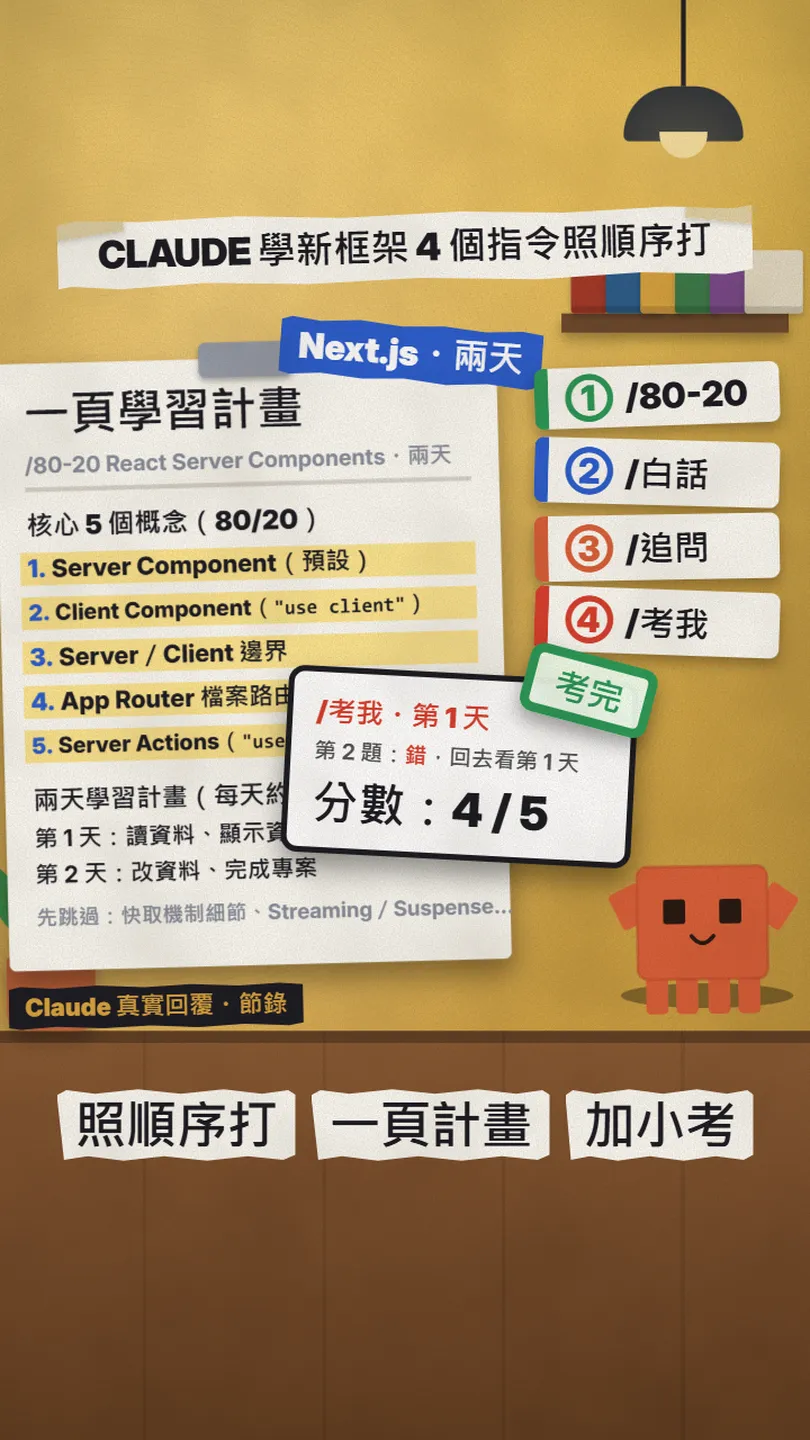
I wanted to learn React Server Components (building with Next.js's App Router) in one weekend. I already know React's useState and useEffect, and I've written Express. In Claude I typed four codes in order: /80-20, /ELI5, /socratic, /quizme. The first gave me a one-page study plan; the last gave me a 5-question quiz. I got one wrong on purpose, and it told me exactly which part of the plan to go back to.
What you'll get from this guide:
- One setup you can paste as is, with all four codes.
- Where to paste it (a Claude Project); it works on the free plan.
- What to type for each code and what Claude actually replied (real replies, 10 Nov 2026).
- Why the order matters.
- For Claude Code users: how to save them as your own commands.
02Step 1: paste the setup into a Project's instructions
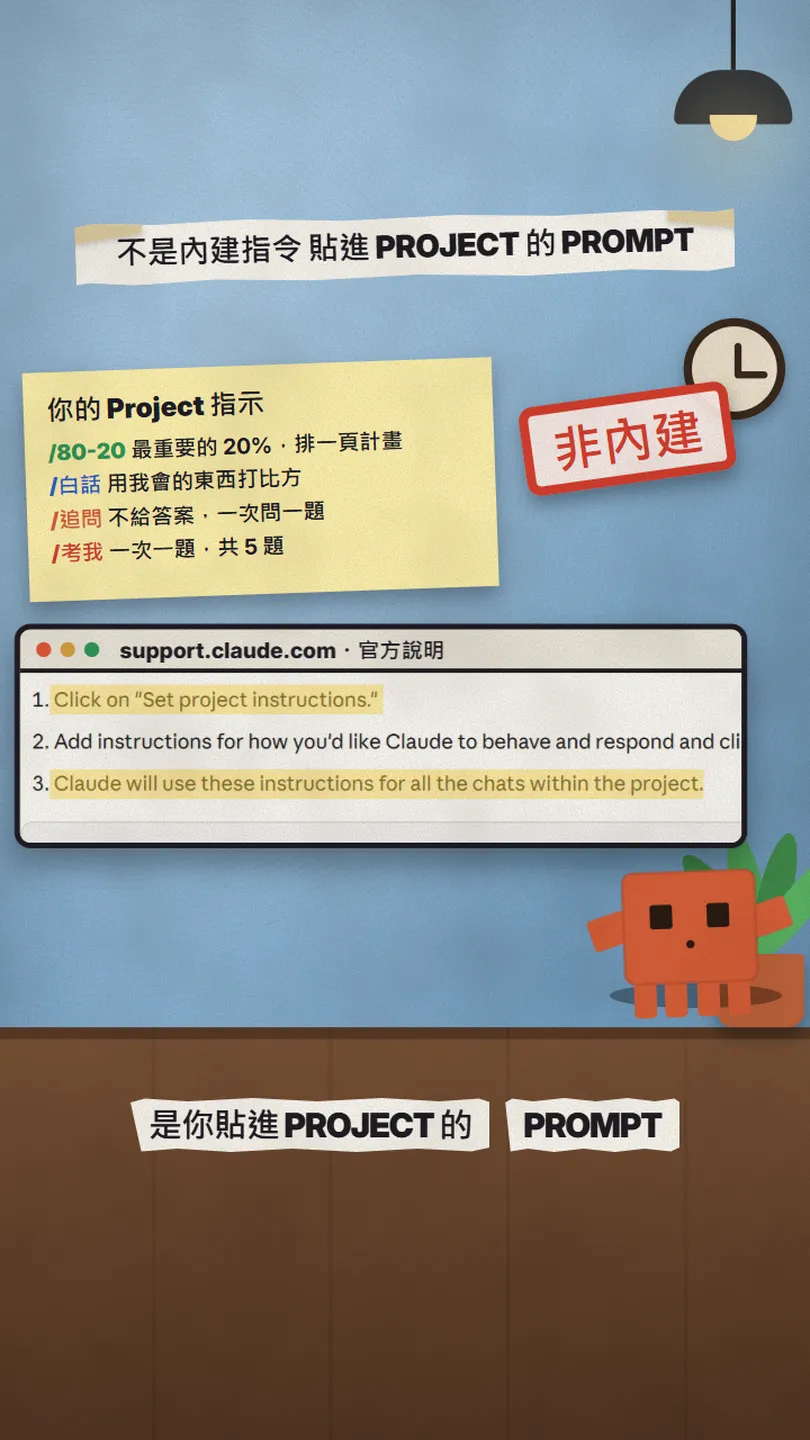
If you just type "/80-20 React", Claude may or may not know what you mean. To get the same rules every time, write them down first. A Project is the best place: its instructions only apply inside that Project and don't touch your other chats.
- Open claude.ai/projects, click "+ New Project" and give it a name (e.g. "Learning").
- In the Project, click "Set project instructions".
- Paste the block below and click "Save instructions".
- Start a new chat in that Project and type a code.
When I'm learning something new I use the four codes below. When you see a code, answer the way it says. Keep it short, no small talk.

/80-20 [topic]
Find the most important 20% of this topic: the part that, once I know it, lets me build 80% of what I'll actually need. At most 5 core concepts, each with one sentence on what it is and one on why it matters. Then make a one-page study plan for the time I give you, with what to learn and a small exercise for each block. End with a list of things to skip for now. Keep it all to one page.

/ELI5 [concept]
Explain this concept with an analogy from something I already know. No jargon; if a term is unavoidable, explain it in one sentence first. End with a one-line summary.

/socratic [concept]
Don't give me the answer. Ask me one question at a time and lead me to work it out. If I get it right, go one level deeper; if I get it wrong, ask a smaller, more concrete question instead of telling me the answer.

/quizme [scope]
One question at a time (multiple choice, or a short code snippet and what it does), and wait for my answer before the next one. After each, say right or wrong and why; if wrong, point me to the concept in the plan I should go back to. 5 questions in total, then give me a score and list what I still need to work on.
03① /80-20: only the most important 20%, as a one-page plan
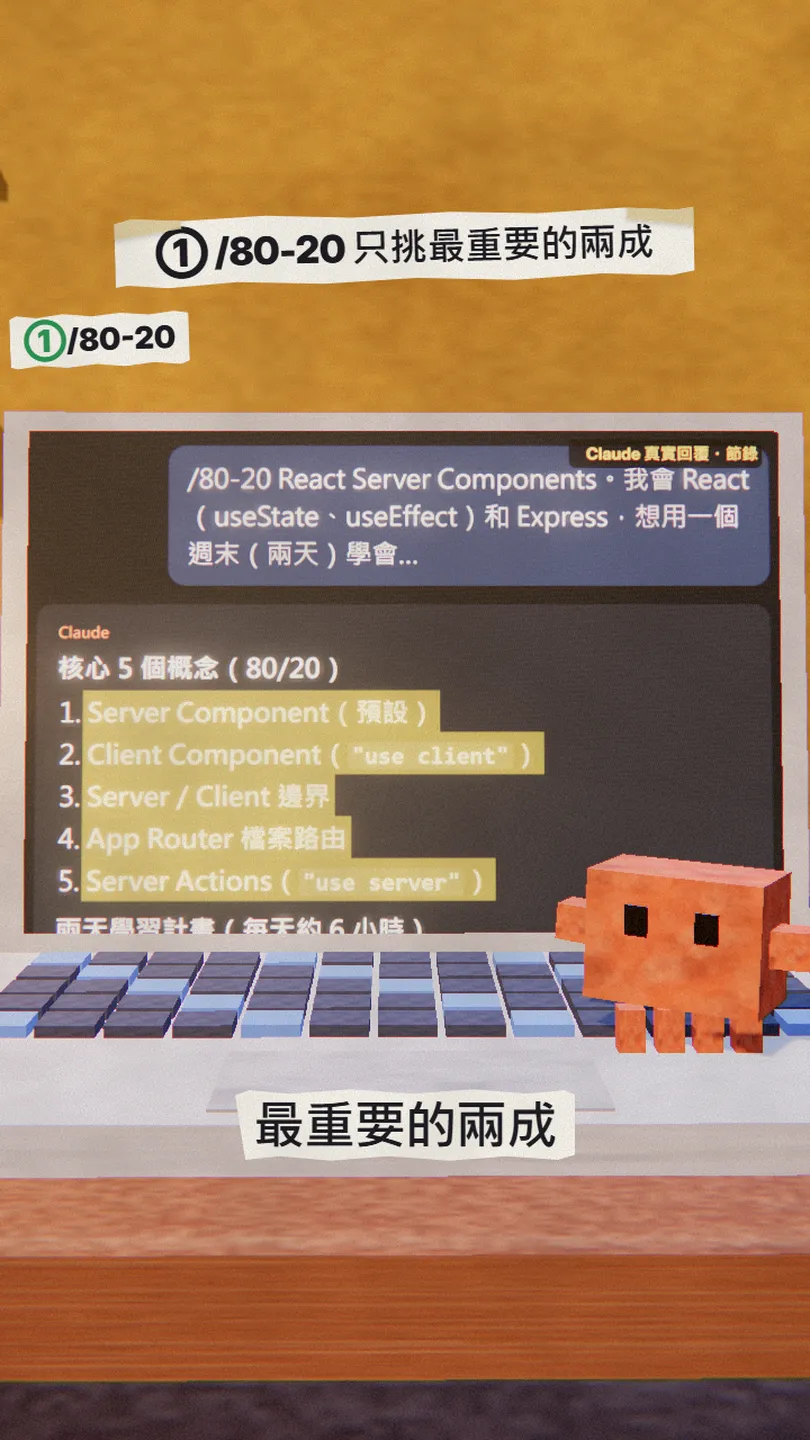
/80-20 [what you want to learn]. I know [what you already know], I want to learn it in [how much time] and build [a small project].
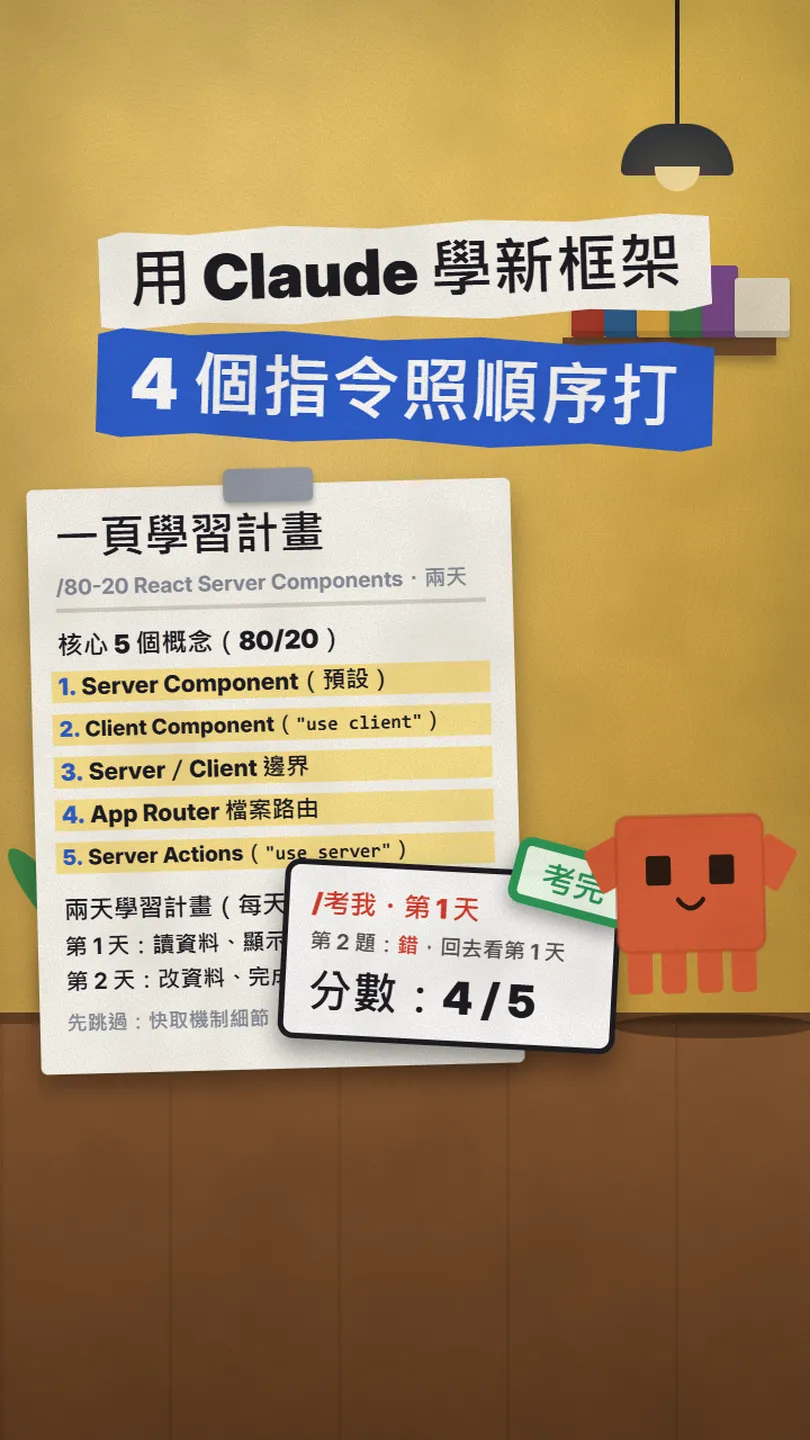
I typed: "/80-20 React Server Components. I know React (useState, useEffect) and Express, and I want to learn it in one weekend (two days) and build a small project with Next.js's App Router." Claude came back with 5 core concepts:
- Server Component (the default)
- Client Component ("use client")
- The Server / Client boundary
- App Router file-based routing
- Server Actions ("use server")
Then a two-day plan (day 1: reading and showing data; day 2: changing data and finishing the project), each block with a small exercise and a last hour for deploying. It also listed what to skip for now: caching details, advanced Streaming / Suspense, Middleware and Route Handlers, authentication and more.
04② /ELI5: explain it with something you already know
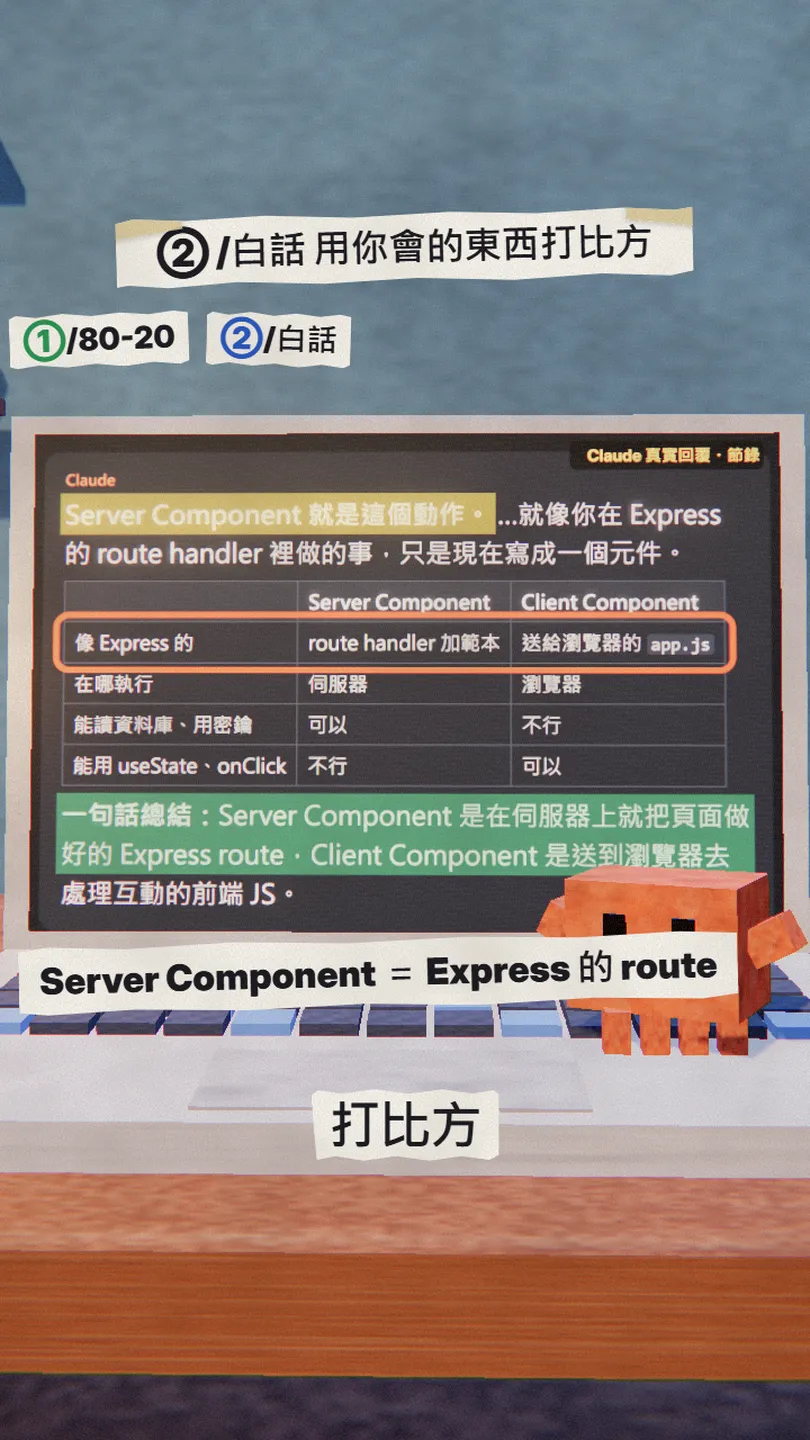
/ELI5 What is the difference between [concepts from the plan]? Explain it with [something you know].
I asked: "/ELI5 What's the difference between a Server Component and a Client Component? Explain it with Express." A Server Component, it said, is like an Express route handler plus a template: it fetches data on the server, builds the HTML and sends it. A Client Component is like the app.js you ship to the browser for buttons and inputs. Its one-line summary: a Server Component is an Express route that builds the page on the server; a Client Component is front-end JS sent to the browser to handle interaction.
05③ /socratic: no answers, just questions
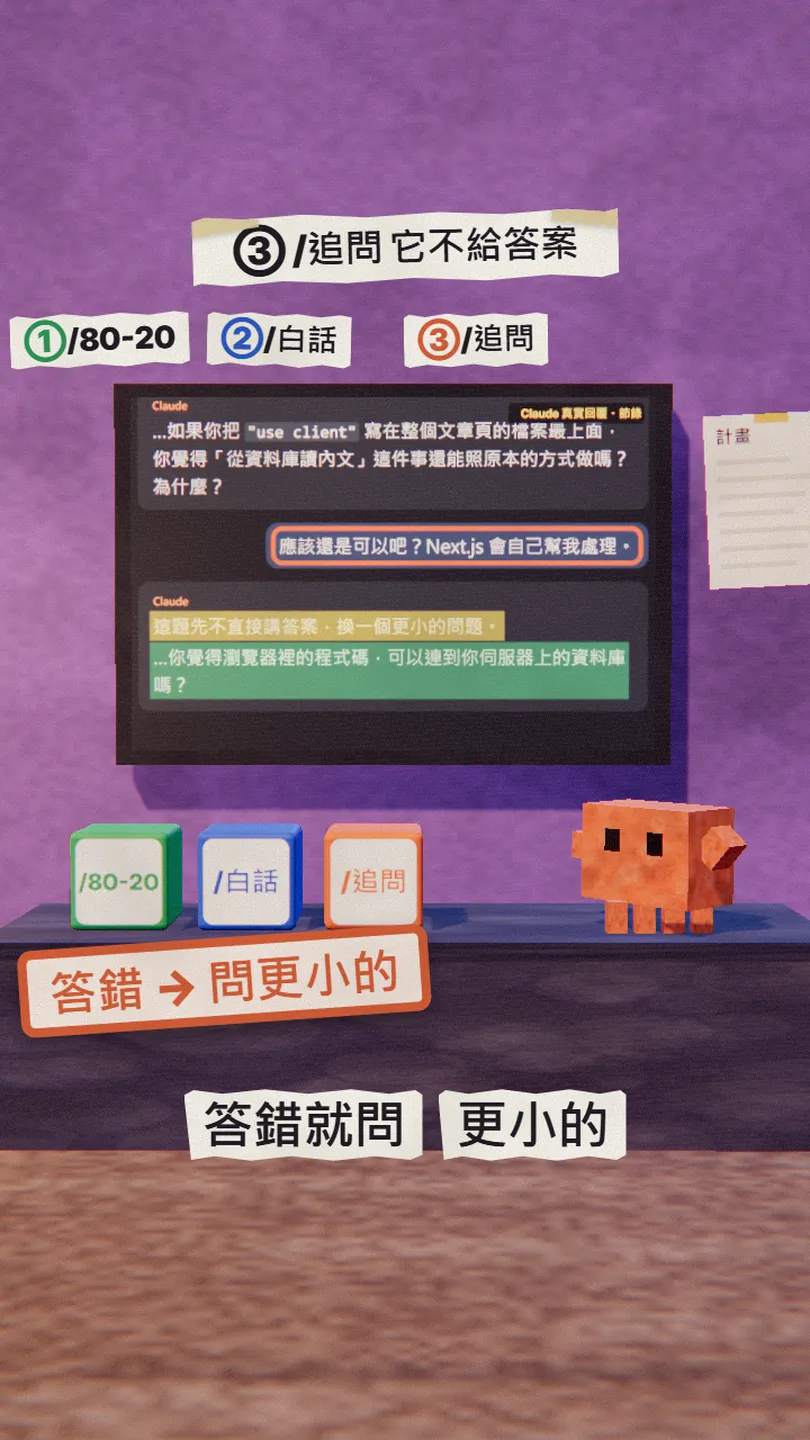
/socratic [a question you want to be sure you understand]
I asked: "/socratic Where should "use client" go?" Instead of answering, it gave me a scene: an article page with body text read from a database and a like button at the bottom. If you put "use client" at the top of the whole article page, can you still read the data the same way?
I answered "Probably yes? Next.js will handle it for me." That's wrong. It didn't tell me; it said it would not give the answer yet and asked a smaller question: can code running in the browser connect to the database on your server? This time I got there myself: put "use client" only in the button's small file. Then it went one level deeper.
06④ /quizme: the quiz comes last, and tells you where to go back
/quizme [scope, e.g. day 1]
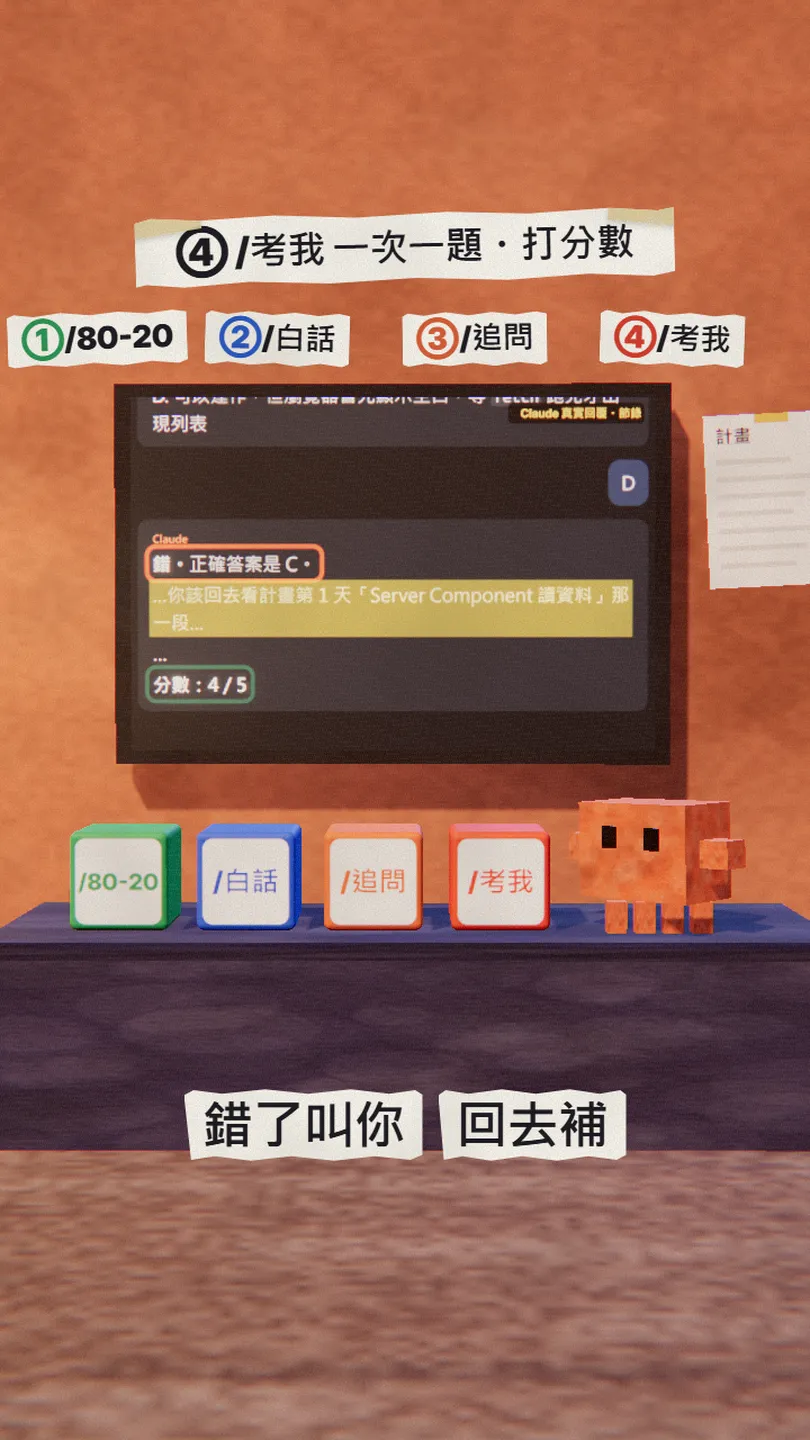
One question at a time, waiting for each answer: multiple choice, or a code snippet and what it does. On question 2 I picked "the browser shows a blank page first". Wrong, it said, the answer is C, and I should go back to the "Server Component reads data" part of day 1. After 5 questions: 4 / 5, plus a list of what to work on.
07Why you shouldn't skip the order
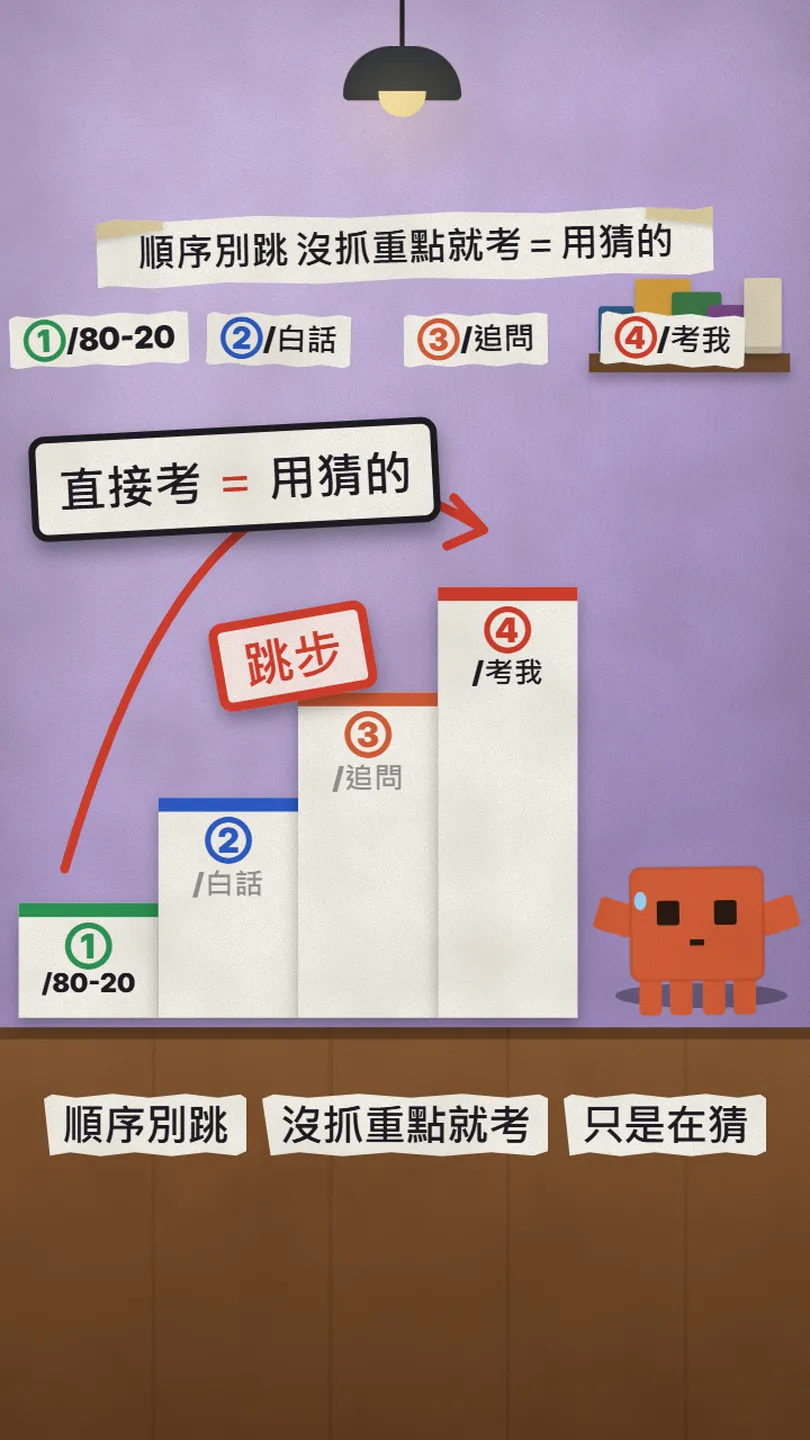
/80-20 decides what you learn, /ELI5 makes it make sense, /socratic checks that you really get it, and /quizme is the final check. Jump straight to /quizme and even a right answer may be a guess; skip /80-20 and you'll be quizzed on things you don't need.
- /80-20 first: get the one-page plan and follow its order.
- After each block, /ELI5 anything that doesn't click.
- When you think you get it, /socratic.
- /quizme before the day ends, and go back to what you got wrong.
08For Claude Code users: save them as your own commands
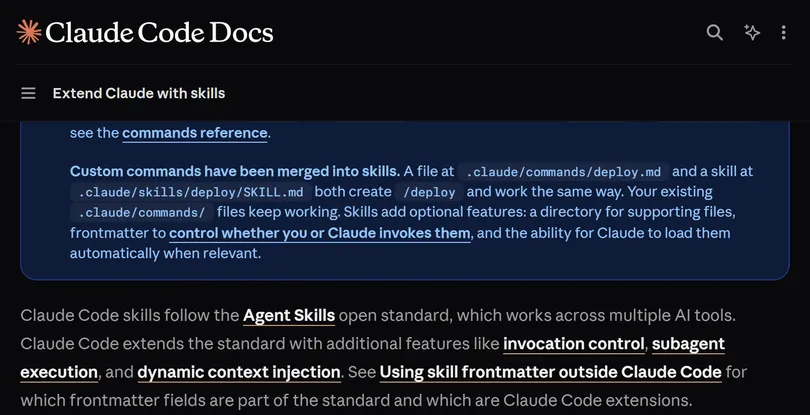
Learning a new codebase in Claude Code? Save the codes as real slash commands. Create .claude/commands/80-20.md in your project: the file name is the command name, so /80-20 runs it, and whatever you type after the command goes into $ARGUMENTS.
---
description: Find the most important 20% of a topic and make a one-page plan
---
Find the most important 20% of "$ARGUMENTS": the part that lets me build 80% of what I'll actually need. At most 5 core concepts, each with one sentence on what it is and one on why it matters. Then a one-page study plan, with what to learn and a small exercise for each block. End with a list of things to skip for now. Keep it to one page.
- Do the same for the other three: eli5.md, socratic.md, quizme.md.
- To use them in every project, make them personal skills instead: ~/.claude/skills/80-20/SKILL.md (as the official docs describe).
- A codebase example: /80-20 how data flows through this project; I only have this afternoon.
09Good to know
- These four codes aren't built into Claude. Typed without the setup, Claude may guess what you mean, or may not follow these rules.
- A Project's instructions only work inside that Project. To use the codes elsewhere, set them up again or paste them into your account-wide Instructions.
- The replies in the reel and here are excerpts of real replies from 10 Nov 2026 (Claude's Sonnet model). With the same setup, each reply will differ in wording and length.
- The learner was us and one answer was wrong on purpose; 4 / 5 is Claude grading those answers, not a promise you'll learn it in two days.
- Still check the technical content against the official docs. We checked these replies against Next.js's Server and Client Components page, and they agree.
Sources
What should the next reel cover?
I test Claude and AI tools every day and turn the useful ones into reels. Follow @vivianlin.tech to catch each new guide.