~/guides/PATTERNS.md
Same question, one extra sentence: 4 lines to paste before any question for better Claude answers
Paste 1 of 4 lines before a question: ask me 3 questions, prove me wrong, give safe/smart/bold versions, answer as a 20-year veteran. Tested on Claude Haiku.
People say Claude's answers are ordinary. Most of the time, I think the question is ordinary. I took one question, "I want to run a hand-drip coffee stall at a weekend market. How do I start?", and asked Claude Haiku five times on 23 Oct 2026: once plain, and four times with one extra sentence in front. Four very different answers. This guide gives you: (1) the 4 sentences, ready to copy, (2) the full answer each one got in our test, (3) when to use which, and how to stack two, (4) what to watch out for. The chat pages are our own mock layout, not claude.ai screenshots, but the text is Claude's unedited answer (in Chinese; translated in this English version). The other images are from our reel, starring our orange block mascot.
01The result first: same question, one sentence apart
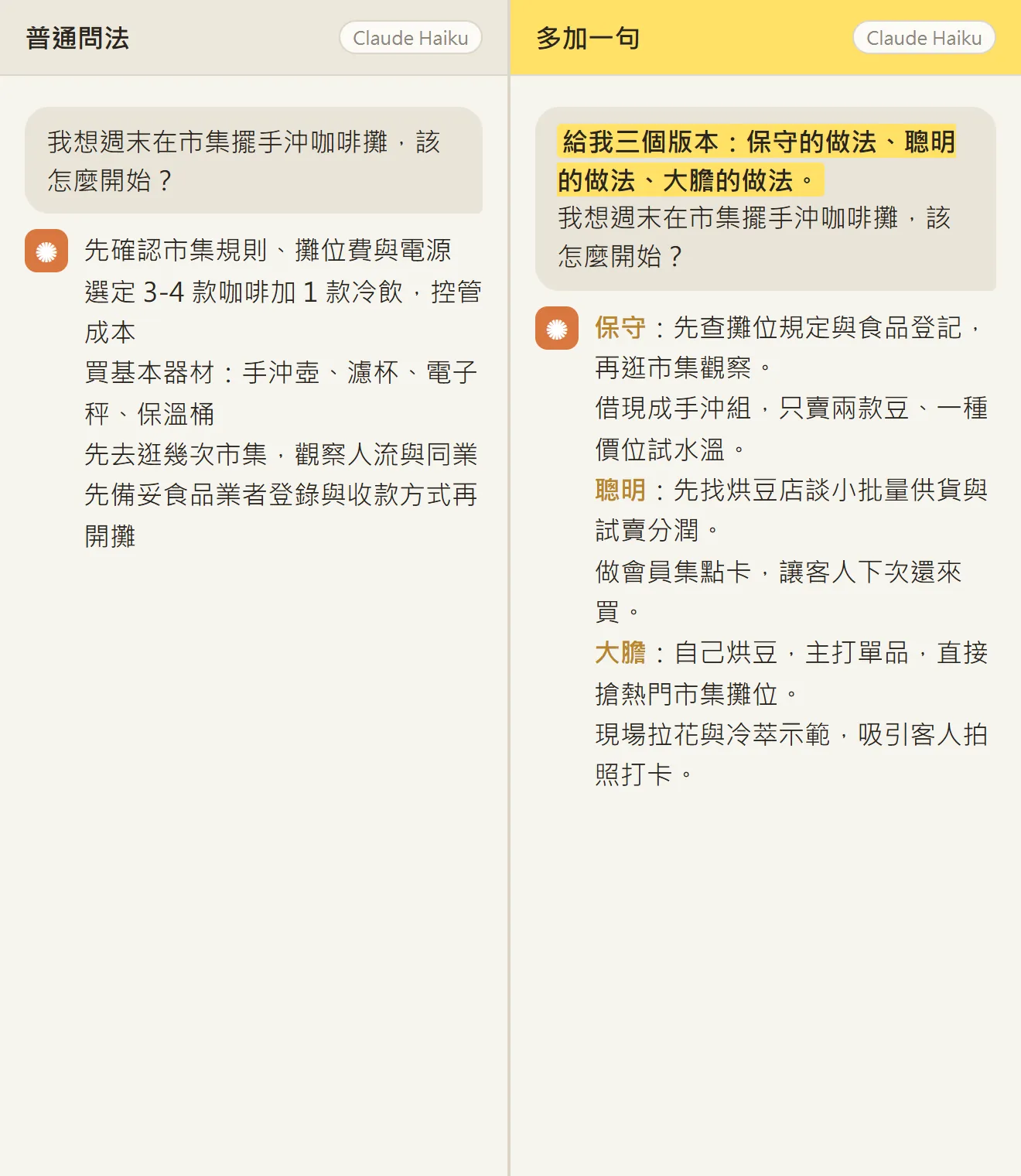
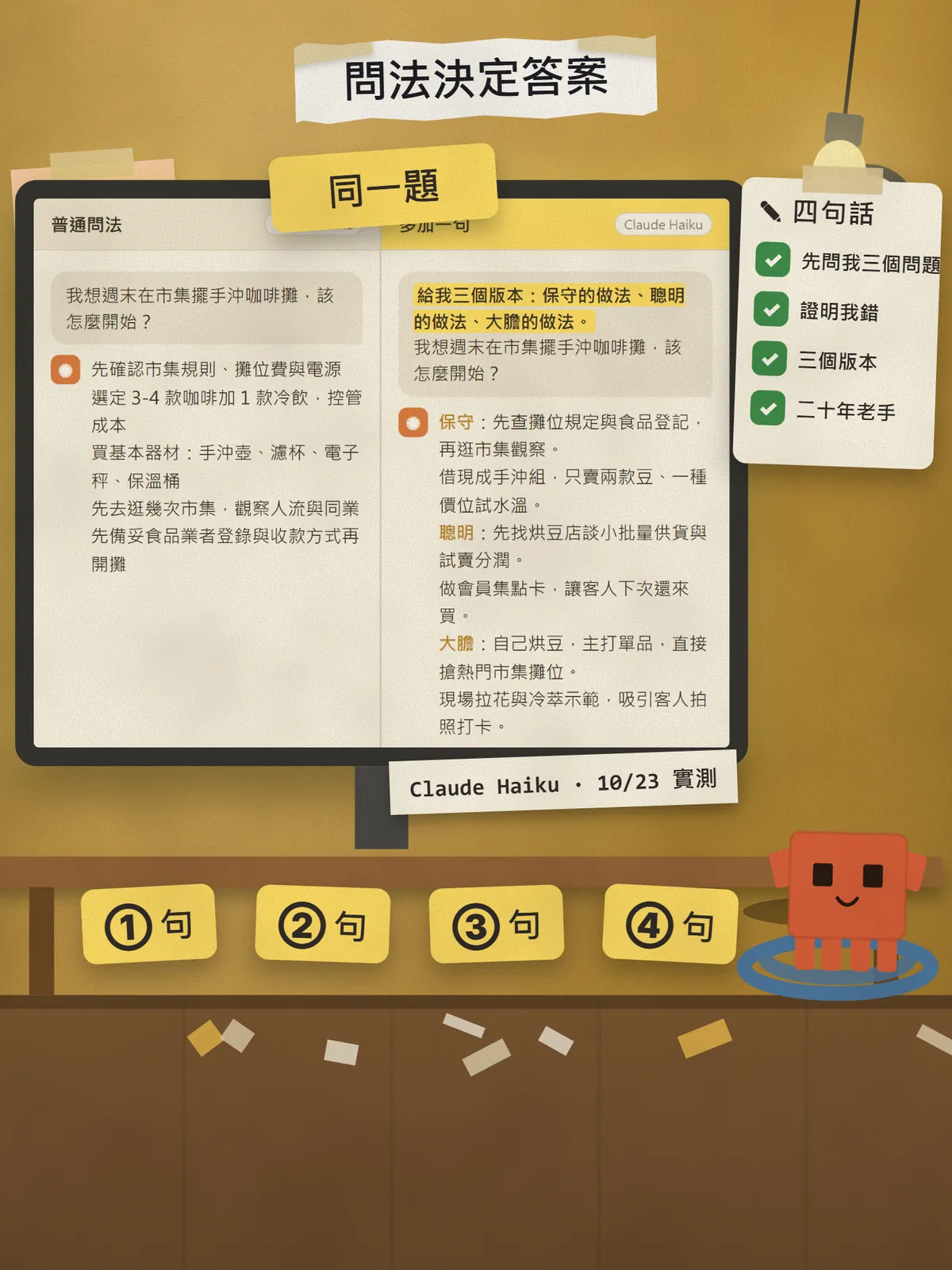
On the left is the plain question. Claude gives a checklist: check the market rules, pick 3-4 coffees, buy the gear, visit the market first, get your food business registration ready. All correct, and about what a web search would give you.
On the right I only added one sentence in front: "Give me three versions: a safe way, a smart way and a bold way." Now it splits into three paths. Safe: borrow a hand-drip kit and sell just two beans to test the water. Smart: get a roaster to supply small batches. Bold: roast your own beans and go for the busiest stall spots. You pick by your budget and your nerve.

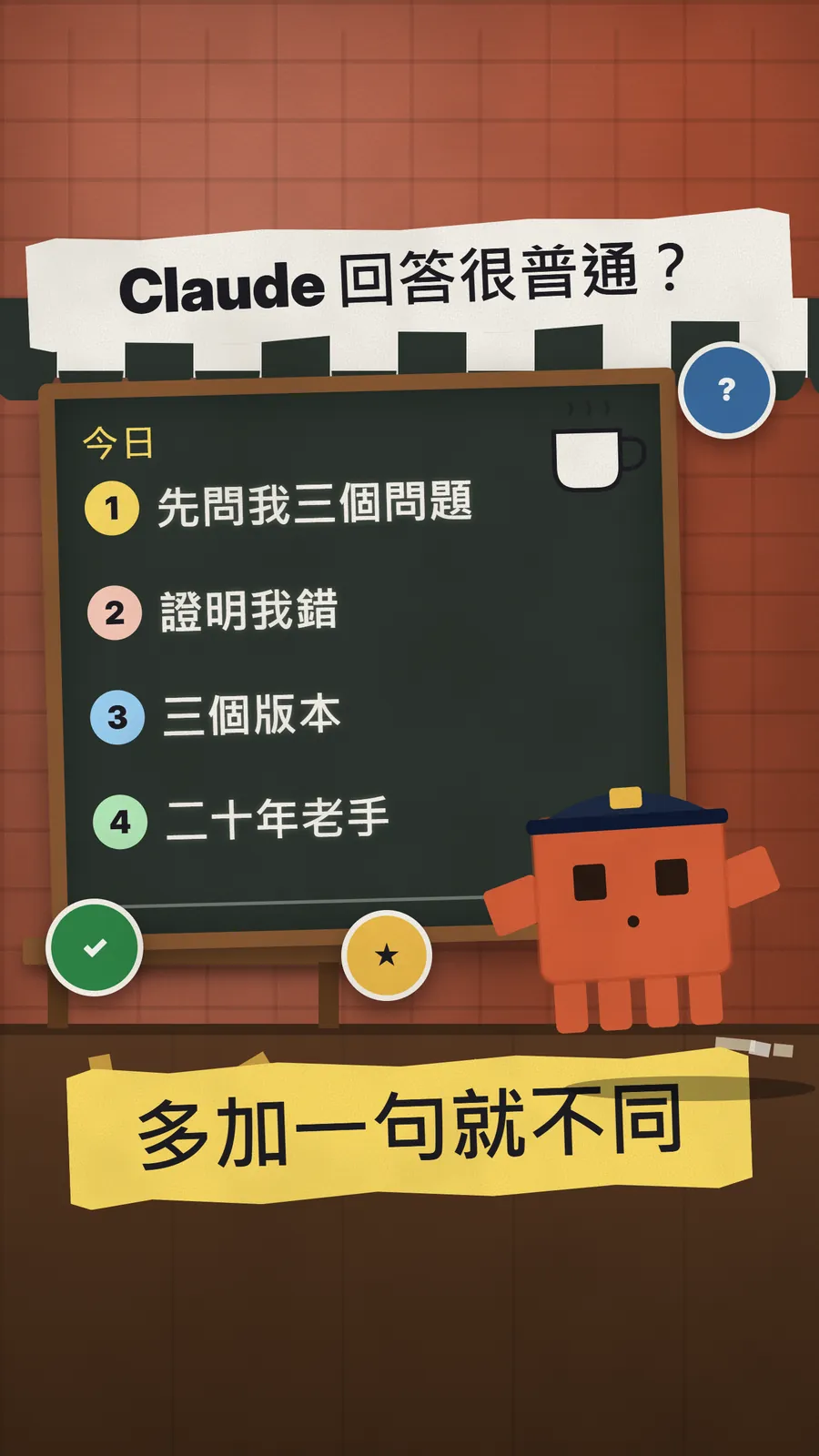
- (1) Ask me three questions first: it gets your situation before answering.
- (2) Prove me wrong: it looks for the holes in your plan instead.
- (3) Three versions: safe, smart and bold, three paths to choose from.
- (4) A 20-year veteran: give it a specific role and the answer gets practical.
Below, each sentence comes with the full text to copy, the full answer from our test, and when it works best.
02How to use it: paste it before your question
- Open Claude (web, desktop or the mobile app) and start a new chat.
- Paste one of the 4 sentences below.
- Start a new line, type your question and send.
- Not happy? Start a new chat, swap the sentence, ask the same question again and compare.
[one of the 4 sentences]
[your question]
03Sentence 1: ask me three questions first
Before you answer, ask me [three] questions you need to know to give me the best answer.
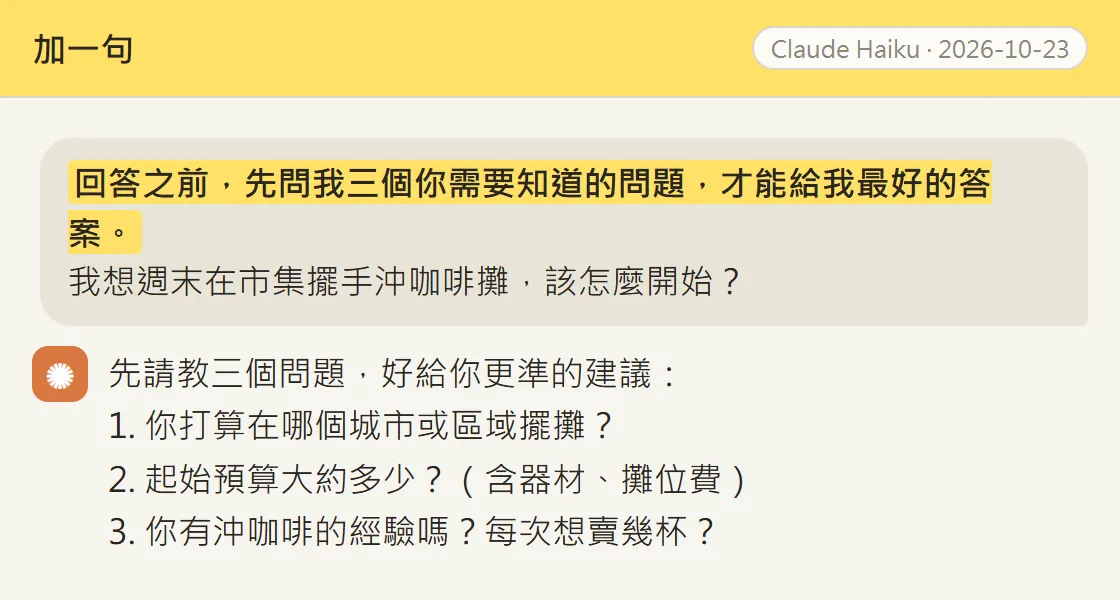
With a plain question, Claude can only guess for an "average person". With this sentence, it asked me three things first: which city, what starting budget, and whether I have brewing experience and how many cups I want to sell each time. Once you answer, the advice is written for your situation.
04Sentence 2: your only job is to prove me wrong
Your only job right now is to prove me wrong.
My plan is: [e.g. running a hand-drip coffee stall at the market this weekend]
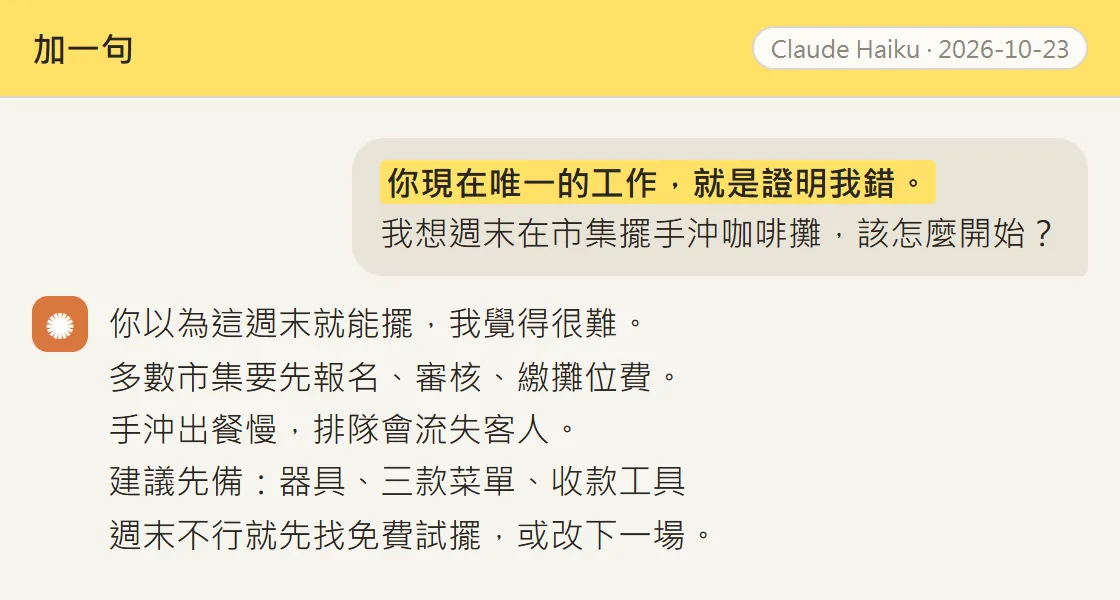
By default Claude tries to help you. With this sentence, it looks for problems first: most markets need you to sign up, pass a review and pay a stall fee, so this weekend is unlikely; hand-drip is slow, and queues lose customers. It still gave me a way out: if this weekend does not work, find a free trial spot or aim for the next market.
05Sentence 3: safe, smart and bold versions
Give me three versions: a [safe] way, a [smart] way and a [bold] way.
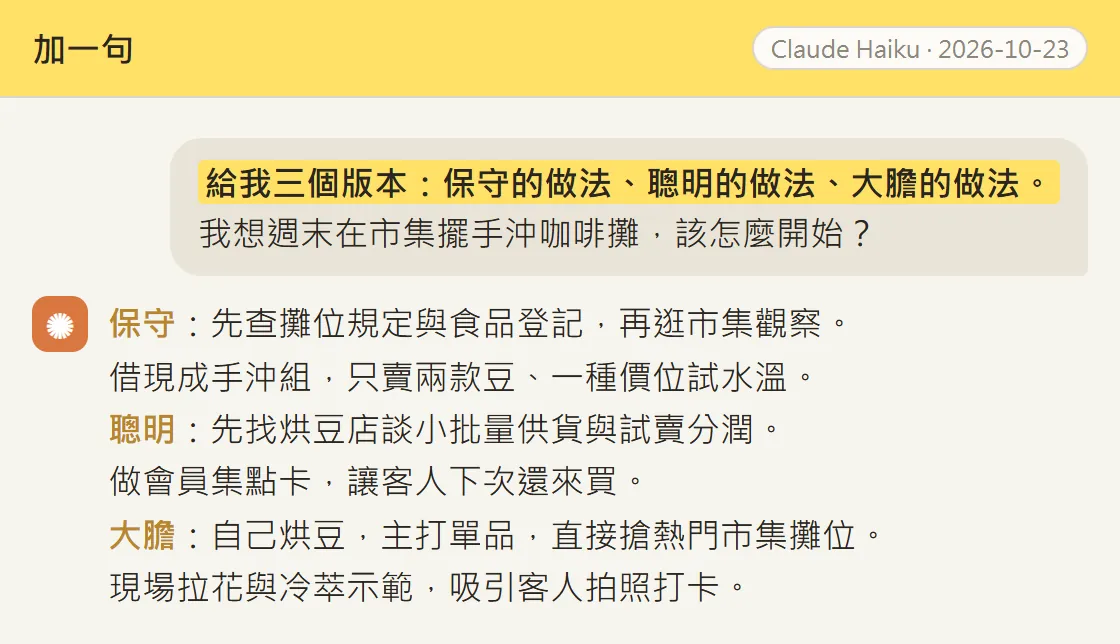
The three versions it gave. Safe: check the stall rules and food registration, borrow a hand-drip kit, sell two beans at one price to test the water. Smart: ask a roaster for small-batch supply and a revenue share on trial sales, and add a stamp card so customers come back. Bold: roast your own beans, lead with single origins, go straight for the busiest stall spots, and draw a crowd with latte art and cold brew demos.
06Sentence 4: answer as a 20-year veteran
Answer as a [veteran] who has done this for [20 years].
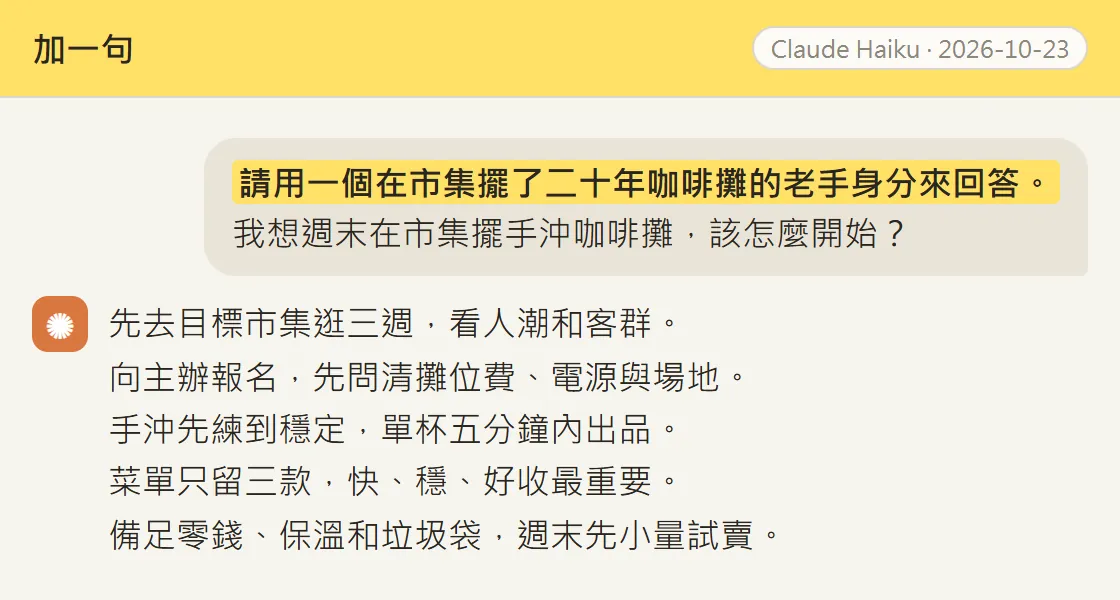
In my test I made the role very specific: "someone who has run a coffee stall at markets for twenty years". Its answer: visit the target market for three weeks to watch the crowd and customers, practise until each cup takes under five minutes, keep just three items on the menu, bring plenty of change and bin bags, and start with a small trial run on a weekend. Compared with the plain question, it adds times and quantities you can actually follow.
Anthropic's own guide, Prompting best practices, has a section called "Give Claude a role": setting a role focuses Claude's behaviour and tone for your use case, and even a single sentence makes a difference. The official guide means the system prompt; in a normal chat I simply put it before the question, and it worked in our test.
07Stack two sentences
You can stack the 4 sentences. The same day I ran Claude Haiku once more with "(4) veteran + (2) prove me wrong" on the same question. It answered (translated):
- I have done this for twenty years, so first, the flaws in your plan.
- One hand-drip cup takes three minutes; a crowd means a long queue.
- A busy weekend does not mean people buy. Go for three weeks and count.
- Ask about the stall fee, power, shade and food registration first.
- Keep two or three items on the menu, and work out cost and price per cup.
- Trial it for a month before deciding. Don't quit your job first.
Answer as a veteran who has [run a coffee stall at markets for twenty years]. Your only job right now is to prove me wrong.
[your question]
It picks holes in the veteran's voice first (slow service, a crowd does not mean sales), then gives steps you can follow (count people for three weeks, work out cost per cup, trial it for a month).
- (1) + (3): answer its three questions first, then ask for three versions, and all three are written for your situation.
- (3) then (2): pick one version, then ask it to prove that version will fail.
- (2) + (4): let a veteran pick holes, the most practical one (the test above is this pair).
08Things to watch out for
- These 4 sentences are not official Anthropic prompts. The official guide covers "give Claude a role" and "be clear and give context"; the other three are common prompting tricks that we tested ourselves.
- We tested on Claude Haiku and also asked it to keep each answer to 5-6 lines so it fits the screen. With another model and no length limit, answers will be longer and differ in detail, but go the same way.
- The same sentence will not give the exact same answer every time.
- "Prove me wrong" makes it argue against you on purpose. If it says no, that does not mean you cannot. Treat it as a checklist, not a verdict.
- The "veteran" is Claude role-playing; it has never run a stall. For stall fees, food registration and other rules, ask the market organiser or the authorities.
- Don't paste ID numbers, bank account numbers or other sensitive data to get a better answer.
- The chat pages in this guide are our own demo layout, not claude.ai screenshots; the text is the unedited answer from 23 Oct 2026, translated from Chinese for this English version.
Sources
What should the next reel cover?
I test Claude and AI tools every day and turn the useful ones into reels. Follow @vivianlin.tech to catch each new guide.